What Are the Job Responsibilities of a CNA in 2026?

Certified Nursing Assistants (CNAs) play a vital role in today’s healthcare system. If you’re considering a career in healthcare, understanding the job responsibilities of a CNA is the first step. From assisting with daily patient care to using modern healthcare technology, today’s CNAs do much more than ever before.

In this guide, we’ll break down what a CNA does, their daily duties, and how the role is evolving in 2026—plus how you can start your CNA career in Omaha, Nebraska.

Job Responsibilities of a CNA

What Does a CNA Do?

A Certified Nursing Assistant (CNA) provides essential, hands-on care to patients in hospitals, nursing homes, assisted living facilities, and home health settings. CNAs work under the supervision of licensed nurses to ensure patients are safe, comfortable, and well cared for.

In short: CNAs are the frontline caregivers who support patients with everyday needs while monitoring their overall condition.

Daily Job Responsibilities of a CNA

While duties can vary depending on the setting, most CNAs perform the following daily tasks:

Basic Patient Care

  • Assisting with bathing, grooming, and hygiene
  • Helping patients dress and use the restroom
  • Supporting mobility (walking, repositioning, transferring)

Monitoring Health

  • Taking vital signs (blood pressure, temperature, pulse)
  • Observing and reporting changes in patient condition
  • Documenting care provided

Mealtime Support

  • Feeding patients or assisting with meals
  • Tracking food and fluid intake

Patient Comfort & Safety

  • Turning or repositioning bedridden patients
  • Keeping rooms clean and organized
  • Responding to call lights and patient needs

Emotional Support

  • Providing companionship
  • Helping reduce anxiety and stress for patients

Job Responsibilities of a CNA in Different Work Settings

Nursing Homes & Long-Term Care Facilities

  • Focus on long-term patient relationships
  • Assist with daily living activities
  • Provide consistent emotional support

Hospitals

  • Work in fast-paced environments
  • Assist nurses with multiple patients
  • Respond quickly to changing conditions

Home Health Care (Growing Field)

  • Provide one-on-one care in a patient’s home
  • Assist with daily routines and independence
  • Build stronger personal connections

Trend Alert: Demand for home health CNAs is rapidly increasing as more patients prefer care at home.

The CNA job description is evolving quickly. Here’s what’s new:

1. Use of Technology in Daily Work

Modern CNAs are now expected to:

  • Use electronic health records (EHRs)
  • Document care using tablets or mobile devices
  • Respond to real-time patient monitoring systems

2. Person-Centered Care

Healthcare is shifting toward individualized care, meaning CNAs:

  • Focus on patient preferences
  • Support emotional and mental well-being
  • Build stronger relationships with patients

3. Increased Demand Due to Aging Population

As the population ages, CNAs are more essential than ever in:

  • Long-term care
  • Assisted living
  • Home health services

4. Expanded Skill Expectations

Employers now look for CNAs who have:

  • Strong communication skills
  • Adaptability in fast-changing environments
  • Compassion and emotional intelligence

Skills You Need to Succeed as a CNA

To thrive in this career, successful CNAs combine technical ability with people skills.

Must-Have CNA Skills:

  • Patient care and safety awareness
  • Communication and teamwork
  • Time management
  • Attention to detail
  • Physical stamina

Bonus Skills (In Demand in 2026):

  • Basic technology skills
  • Experience with electronic charting
  • Ability to work in home health settings

CNA Career Path Opportunities

Starting as a CNA opens the door to many healthcare careers.

Many CNAs go on to become:

  • Licensed Practical Nurses (LPNs)
  • Registered Nurses (RNs)
  • Medical Assistants
  • Healthcare administrators

If you’re exploring a long-term CNA career path, this is one of the fastest ways to enter the medical field.

Is Being a CNA a Good Career in 2026?

Yes—being a CNA remains one of the best entry-level healthcare jobs.

Benefits of Becoming a CNA:

  • Fast training programs
  • High demand and job security
  • Opportunities for career advancement
  • Meaningful, hands-on work helping others

Start Your CNA Career in Omaha, Nebraska

If you’re ready to begin, choosing the right training program is key.

At Quality Career Pathways, students receive:

  • Hands-on training
  • Exam preparation
  • Support from experienced instructors

Whether you’re just starting or changing careers, CNA training can help you quickly enter the healthcare field.

This post does not guarantee employment or specific earning potentials, it simply represents the variety of career opportunities to our students.

What is the difference between a CNA and a CMA?

If you’re exploring healthcare career options in Nebraska, you’ve likely come across both CNA courses and CMA courses. Because the roles often overlap, many students wonder: What’s the difference between a CNA and a CMA class? Let’s break it down so you can decide which course best fits your goals.

CNA Course Overview: Certified Nurse Aide

Certified Nurse Aide (CNA) is a vital part of the healthcare team. CNAs work directly with patients to provide hands-on care and support for daily activities.

Common CNA job duties include:

  • Checking and recording vital signs
  • Assisting patients with bathing, grooming, and dressing
  • Making up patient beds and maintaining a clean care environment
  • Helping patients move safely or transfer between beds and wheelchairs

After completing a state-approved CNA course, students must pass both a written/oral exam and a clinical skills exam to earn their CNA certification.

The CNA program at Quality Career Pathways includes 76 hours of classroom and clinical training (75 hours of coursework plus one hour of abuse and neglect training). Graduates are prepared to work in hospitals, long-term care facilities, assisted living centers, and even private homes.

CMA Course Overview: Certified Medication Aide

Certified Medication Aide (CMA) builds on CNA-level knowledge and focuses specifically on medication administration under the supervision of a licensed nurse.

Typical CMA responsibilities include:

  • Administering oral and topical medications
  • Following the “five rights” of medication administration (right patient, right drug, right dose, right route, right time)
  • Documenting medication administration accurately
  • Assisting clients with daily tasks such as meals, dressing, and personal hygiene

The CMA course at Quality Career Pathways requires 40 hours of training, after which students are eligible to take the state CMA exam.

This certification allows you to advance your healthcare career, take on more responsibility, and often increase your earning potential.

CNA vs CMA: The Key Differences

While both CNAs and CMAs provide essential patient care, the main difference between a CNA and a CMA is medication administration.

  • CNA: Trained in client care—helping with hygiene, mobility, and comfort—but not authorized to administer medication.
  • CMA: Certified to administer medications under nursing supervision but typically does not perform mobility or transfer tasks taught in the CNA course.

Because of this, many students choose to become dual certified (completing both the CNA course and the CMA course) to expand their skills, job opportunities, and versatility in healthcare settings.

Training Time and Career Opportunities

CertificationTraining HoursFocusCommon Workplaces
CNA Course76 hoursPatient care and comfortHospitals, nursing facilities, clinics, in-home care
CMA Course40 hoursMedication administrationAssisted living facilities, long-term care, residential settings

These two certification programs are the cornerstone healthcare training options at Quality Career Pathways (QCP) and will prepare you to work in a variety of healthcare environments.

Another Difference Between a CNA and a CMA: Salary

In general, CNA salaries are slightly higher than CMA salaries because CNAs complete more training and have a broader range of clinical responsibilities. However, pay can vary depending on employer, experience, and location.

For the most accurate wage information, you can visit the U.S. Bureau of Labor Statistics website to explore the latest data on CNA and CMA salary projections.

Which Course Is Right for You?

When choosing between a CNA course and a CMA course, consider your long-term goals:

  • If you want to start your healthcare career quickly and want to work with medications, the CMA course is a great place to begin.
  • If you enjoy more responsibility and focus on patient care, the CNA course may be the better fit.
  • If you want the most career flexibility, consider earning both CNA and CMA certifications through Quality Career Pathways.

Both career paths allow you to make a meaningful impact by improving the health and well-being of those in your care.

Enroll Today in a CNA or CMA Course at Quality Career Pathways

Ready to take the next step?

Start your CNA course or CMA course in Omaha. Our hands-on programs, flexible scheduling, and supportive instructors will prepare you for success in Nebraska’s growing healthcare field.

Disclaimer: This article is for informational purposes only and does not guarantee employment or specific earnings.

difference between a CNA and a CMA

Preparing For A Career Change

Some people find their career calling in high school. They know what they want to become, set the course to make that happen, and spend their adult life doing what they love. If you are one of those people, congratulations!

However, that is not the case for many people. Consider this:

  • Nearly 20% of college freshmen have an undeclared major
  • Almost 80% of college students change their major at least once before they graduate
  • Close to 50% of people will switch careers in their lifetime – and that is a complete career switch, not just getting a new job in the same field

So, it is okay to change your mind!

Make Your Past Work For Your Future

As you consider where you’d like a new career to take you, don’t forget to take stock in what you have already accomplished that can be applied:

Transferable Knowledge: For example, you may not think that experience as an accountant can transfer to a new career as an interior designer, but there are skills that overlap, like managing budgets. Take a deeper look at your skill set from your past experience and get creative when promoting them to a new employer. 

Professional Tenure: Whether you have been loyal to a company for some time or you have bounced from job to job, hiring managers will take note. Make sure you are ready to show that you are willing to transfer your loyalty to a new company. Or, show that your multiple jobs created new professional skills at each step along the way. 

Personality Traits: Some employers hire based on the company culture they are trying to create. They may select a person with fewer job-specific skills if the personality is the right match. Be charismatic!

Personal Network: Don’t be afraid to ask for help. If you know someone in the field you are considering, ask them to coffee to discuss the pros and cons. Then, when it is time to start applying, utilize places like LinkedIn to see who you may know at companies of interest. If you find a connection of a connection – ask for an introduction. 

Get The Training You Need

Some career changes will require additional education or training.

If you are ready to see if a new career in medicine could be a good fit for you, consider a certification course, like our CNA class. It is the perfect opportunity to see if you enjoy the material before extending your education to a 2-year or 4-year college.

Plus, there are plenty of job openings for CNAs, so you don’t necessarily need additional training beyond the 76-hour course to start a new career.

You Can Make A Change • We Can Help

How Will Artificial Intelligence Effect CNAs and CMAs

Artificial Intelligence “AI” is making its way into a variety of career paths – including the medical field. These advancements will allow professionals to spend more time helping patients, and less time working on administrative tasks. Read on to learn about the areas where it could make the biggest impact on the care patients receive.

Medication management and dosage calculation: AI systems can assist in accurately calculating medication dosages, checking for potential drug interactions, and ensuring adherence to prescribed medication schedules. This can help reduce errors and improve medication safety.

Assistance with administrative tasks: AI systems can automate and streamline certain administrative duties, such as scheduling appointments, managing patient records, or updating charts. This can free up time, allowing them to focus more on direct patient care.

Enhanced diagnostics and monitoring: AI-powered technologies can help monitor patients’ vital signs, recognizing patterns, and providing early warnings for potential health issues leading to proactive care and interventions. Monitoring could even be done remotely and can improve the accuracy and efficiency of patient assessments.

Smart medication dispensing systems: AI-powered systems can automate the process of preparing and dispensing medications, ensuring the right medication is provided to the right patient at the right time. These systems can also track medication inventory and alert medical professionals when refills are needed.

Remember, while AI can improve efficiency and accuracy in medical-related tasks, human oversight and judgment remain essential. Health care professionals should continue to exercise expertise, empathy, and critical thinking skills when caring for patients. That is why your Quality Career Pathway’s education remains so important! 

Employer-Paid Tuition

If given the opportunity, most employers would rather promote from within instead of hiring someone new. If you currently work in a medical setting and are interested in advancing your career as a CNA, CMA, or Pharmacy Technician, consider talking to your manager or HR representative. Here’s how:

  1. Schedule a meeting: Explain that you are looking for additional responsibilities and you’d like to set aside a few moments to talk about what that could look like.
  2. Do some research: Before going into the meeting, understand the training time and cost commitments for the course you’d like to take. Take a look at our pricing page for more details about our programs.
  3. Present your goals: Explain the role you are seeking and the research you have gathered. Your manager or HR representative should then share the company’s prerequisites for the job. 
  4. Ask about tuition reimbursement: If they haven’t mentioned it already, ask if the company has a tuition reimbursement program. If so, make sure you understand all the criteria around the program, such as when and how the reimbursement takes place and how long you need to stay with the company. 
  5. Enroll in a course: Once you understand the steps your company requires to advance, View Our Course Calendars, select your class time, and enroll.

Curious How The Online Portion Of Your Course Works?

Let Us Show You What to Expect

First, you will get access to your online materials as soon as you enroll in a course and make a payment. You do not have to pay in full to get access (but you can). If you signed up for a payment plan, you simply need to make your first payment.

Next, you will get an email with a link to the Learning Management System (LMS). This is where all your materials are located including content presentations, videos to watch, and quizzes to take. Yes, you will be taking periodic quizzes online to ensure you are comprehending the material.

You can access the LMS through the link that was in your email, or there is a link at the top of our website that will take you to the system’s log in page. You will log in with your email and a system-generated password which you will change upon initial log in.

Your Course Home Page Will Start With An Overview Video

This will show you how to navigate through your material and outline exactly what is expected from you. Please watch it so you are armed with all the information you need.

Tracking Your Progress

There are three ways you will be tracked online to ensure you have completed all the required elements before coming to the school for your in-person skills training and final testing:

Completing the course material: There is a course outline listed on your course homepage that includes all lessons, worksheets, and exams that are required. It is broken into Units to help you better organize your time. Beside each element is an icon that shows you the format:

Training time spent with the material: When you start a new element, a course timer will track how long you are spending with the material. To complete the course, you must review each section AND spend the minimum course requirement hours with the content. For example, for the CNA course, you must spend at least 44 hours with the online content. If you follow the prompts, you will easily reach both your content and timed goals.

Quiz scores: There are several quizzes throughout your course to ensure you are understanding the material. Your score will be calculated at end of the quiz and must achieve a specific score to proceed. Each course and exam has different criteria for passing and the system will let you know if you need to retake a quiz.

CMA Testing onsite

Material Details: The Audio Presentations

With audio presentations, you will be listening to the instructor lecture, sometimes with visuals and sometimes without. Please note that there is not a fast forward function. So once you start an audio presentation, if you stop and come back later, you will restart the material in that section again. The audio presentation segments range from 5 minutes to 60 minutes a piece, so take a look at the section’s time ticker before you start.

Material Details: The Videos

The videos are generally there to show you a skill that you will eventually practice when you get to the school. Many students like to revisit these videos right before coming to class.

Material Details: The Quizzes

At the end of each Unit, there will be a quiz. You will be presented with one question at a time and your score will be provided at the conclusion.

After a set amount of time, the quiz will time out and you will receive your score. If you need to retake the quiz, please revisit the prior material to review, then attempt again.

The Progress Report

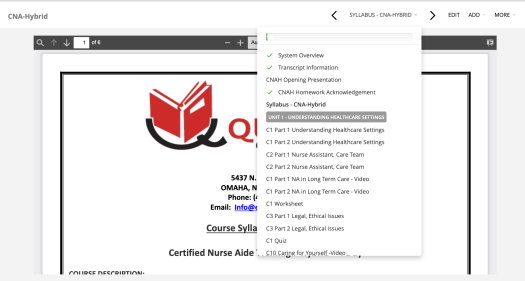
At any point, you can check your progress through the course by clicking on the menu bar at the top of the screen. A green check will appear next to all the material that you have completed. In the example below, the CNAH Opening Presentation was not completed. You will need to have all sections checked before coming to the school for in-person class.

Additionally, at the completion of a Unit, you will get a summary of your progress. It will show your course completion percentage and your time summary.

Let’s Get Started

Now that you know what to expect online, get enrolled in a course, and get started.

Frequently Asked Questions About CMAs

A Certified Medication Aide (CMA) has the skills to administer medication and monitor its effectiveness. The CMA course, along with the CNA course, were the first to be offered at Quality Career Pathways and remain our core classes. Because we have been graduating CMAs since 2011, we have fielded our fair share of questions about this profession. Below are the ones we get asked most often.

CMA taking medication

What is the difference between a Certified Medication Aide and Medical Assistant?

This is the most popular question we receive. While the names may sound similar, they are very different certifications and job titles. A Certified Medication Aide course takes 40 hours to complete and covers the skills required to administer and monitor a patient’s medication. To become a Medical Assistant, your training will take approximately 9 months to 2 years depending on your course load.

While medication administration skills are included in a Medical Assistant program, you will learn additional medical skills in a program like this, such as chart and code reading, surgical assistance procedures, ECG training, sample collection methods, and more. This level of training requires a higher time and cost investment.

Please note: Quality Career Pathways only offers a Certified Medication Course

Should I become a CNA or a CMA?

This is a question only you can answer. What we can do is tell you about the differences between a CNA and a CMA. The CNA course takes a more comprehensive patient care approach and teaches you how to check vital signs, monitor a patient’s safety and wellbeing, and assist with personal tasks. The CMA course is specifically designed to focus on medication administration and monitoring.

So you may be thinking: if I become a CNA, do I also need a CMA certification?

While there are some aspects of medication awareness taught in a CNA course, the level of detail may not be enough for some employers to allow you to administer medication. Some may require the additional CMA certification to do so. Think of it this way, medication is just one part of the overall care plan for a patient. As a CNA you learn the skills to care for the patient’s personal needs. As a CMA you learn the skills to care for the patient’s medication needs. With a dual certification, you can care for the whole person.

How long does it take to become a CMA?

The Quality Career Pathways CMA Class is a 40 hour course and is offered as an online hybrid. You will complete 24 hours online before coming to the school for 12 hours of hands on training and testing. Courses are offered at our main Fort Campus or our new Vinton Campus.

What is the salary range of a CMA?

While we cannot predict salary levels, you can check projections at with the US Bureau of Labor Statistics HERE.

What are the career outlook for a CMA?

A Certified Medication Aide can work in a variety of medical settings. Basically anywhere that administers medication to patients can be a future workplace for you, including hospitals, in-home medical care, nursing homes and more.

Ready to get started?

This post does not guarantee employment or specific earning potentials, it simply represents the variety of career opportunities to our students.

What are the CNA Salary Predictions for Omaha?

A certified nursing assistant (CNA) helps patients with their daily tasks such as getting dressed, serving meals, and administering medications. A CNA is responsible for the safety and well-being of their patients. They play an important role so that registered nurses have time to take care of patients’ medical needs.

Average Salary of a CNA

While we cannot predict salary levels, you can check projections at with the US Bureau of Labor Statistics HERE.

Salaries can fluctuate based on multiple factors such as job availability, education levels, work experiences and more. 

Education Needed to Become a CNA in Nebraska

Certified Nursing Assistants are professionals and therefore the job requires professional training. Fortunately, that training does not take long to obtain nor is it particularly expensive. 

In Nebraska, a CNA requires a certification, not a license. To complete CNA certification, a candidate must enroll in a state-approved CNA program and achieve a passing score on the competency exam.

The cost of certification varies depending on the certification program chosen, but the average tuition for a CNA certification program in Nebraska is about $500 for tuition, books and exams. Uniforms may be an additional expense in some programs.

The total time it takes to complete a CNA program is 76 hours. Some certification programs can be completed in two weeks. Others offer evening classes or weekend classes that are spread out longer than two weeks. 

Job Prospects for Nebraska CNAs

Certified Nursing Assistants are in high demand. At any given time, there are thousands of CNA job listings in Nebraska. CNAs can work in hospitals, nursing homes, assisted living facilities, schools, private homes, doctor’s offices and other medical businesses where nursing assistance is required. 

Many states also offer reciprocity for Nebraska certified CNAs so a professional’s certification can travel from state to state. Most states require some fees to issue a new certificate, but they do not require additional coursework or exams. Since each state has individual requirements, Nebraska CNAs should research the requirements in each state they’re interested in. 

The cost and time it takes to obtain CNA certification in Nebraska are minimal. With a little investment of time, it won’t be long before someone wishing to be a certified nursing assistant can obtain a career helping others that comes with a good starting salary.

This post does not guarantee employment or specific earning potentials, it simply represents the variety of career opportunities to our students.

How to Become a Certified Nursing Assistant (CNA)

Certified nursing assistants, or CNAs, in Nebraska, must meet specific requirements to be fully certified and have the ability to practice. CNAs in Nebraska are under strict authority by the Nebraska Department of Health and Human Resources, DHHS, to ensure the best care for patients that are utilizing CNA care. Before becoming a CNA in Nebraska, a person must meet training and exam requirements.

After meeting training and exam requirements, CNAs will get their name posted on the Nebraska registry. This will allow you to get a job as a CNA within the state.

If you want to learn more about becoming a Certified Nursing Assistant in Omaha, reach out to our team today at (402) 609-9583 or email us at Info@EnrollAtQuality.com.

Become a CNA Today

CNA Training and Exam Requirements in Nebraska

To get one’s name on the Nebraska CNA Registry, an aspiring CNA must complete extensive training and be able to pass certain exams. Training and exam requirements will ensure that CNAs are knowledgeable and skilled in their practice, and will be able to provide the best possible care to their future patients. To begin the training and exam process, one must choose which route they are taking to become a CNA and must complete an in-depth application; applicants must be at least 16 years of age.

Select the Right Program and Meet the Requirements

There are a number of different programs throughout Nebraska, and choosing the one that fits one’s lifestyle/needs is important. QCP offers one of the leading programs in Nebraska, with individuals completing their certification on average between 5-6 weeks.

For new CNAs, the first certification requirement is to complete a 75-hour nursing assistant training program. In addition to the 75-hour intensive nursing training, CNA students must also complete a one-hour training course that details reporting abuse and neglect.

Alternate Certification Routes

If an individual is a CNA from out-of-state, he or she does not have to complete the full 75 hours of training as long as he or she can prove with documentation that he or she already completed it. However, out of state CNAs will have to take the one-hour training course that details abuse and neglect, no matter his or her CNA circumstances.

True for both out-of-state CNAs and RNs and LPNs with lapsed licenses, individuals must complete and pass the CNA evaluation exam if they have not practiced nursing in 24 months.

If a nurse is trained in the military or is a foreign-trained nurse, he or she may be exempt from the CNA examination after submitting a letter to the DHHS with an attachment that details one’s credentials.

Complete State-Approved CNA Training

Individuals that are just beginning their CNA training and have selected their program will begin state-approved training. CNA courses must go over a minimum number of topics determined by the state of Nebraska. The standard curriculum for CNA courses in Nebraska (excluding CNAs that want to work with individuals with developmental disabilities) includes:

  • Basic nursing skills, such as maintaining a patient’s environment/comfort, taking and recording a patient’s vital signs, etc.
  • Personal care skills, such as feeding, bathing, turning and repositioning patients
  • Learning resident rights, including, confidentiality and avoiding restraints
  • Learning specifics of mental health in patients; this covers topics having to do with the aging process, residents’ personal choices and how to provide emotional support
  • 16 hours of infection control training, communication skills training, and emergency procedure training
  • Learning how to provide restorative services such as maintaining range of motion and the use of assistive devices

Passing the CNA Exams

When an individual completes the appropriate Nebraska CNA training, he or she must pass competency evaluation exams.

Written and Oral Exam

In order to pass this portion of the CNA exam, an individual must score at least a 70%. This portion of the exam is made up of 50 questions, and each individual gets three attempts to pass before he or she has to retrain and then try again.

Skills Exam

The next portion of the exam requires individuals to perform six skills; these skills can include anything from measuring a patient’s blood pressure or body temperature, to measuring the output from a urinary bag. An individual must pass all six skills; three attempts are allowed before he or she must retrain and retest.

The Application Process to be Placed on the Nebraska CNA Registry

Individuals that complete the standard curriculum and evaluation do not need to apply in order to be placed on the Nebraska CNA registry, the department will be notified after the evaluation has been passed. An individual should expect to see his or her name within 30 days of the department being notified.

If an individual has taken an alternate route in order to become a CNA, he or she must submit the appropriate documentation (graduate certification or RN/LPN license) as well as a cover letter that requests placement on the Nebraska CNA Registry.

What Happens After an Individual is a Certified Nursing Assistant in Omaha?

Having a CNA certification opens a number of doors for an individual interested in the medical field. Typically, CNAs are employed in long-term care facilities and nursing homes that are funded by Medicare/Medicaid, or they practice as private duty nursing assistants. Whether becoming a CNA is a step towards a future in the medical field, or it is the beginning of a career, becoming a certified nurse aide in Nebraska is worth one’s while.

This post does not guarantee employment or specific earning potentials, it simply represents the variety of career opportunities to our students.

This is default text for notification bar